If you live in Silver Bluff, you already know the arithmetic. Coral Way backs up. US-1 stalls. Drivers who know the neighborhood — and plenty who don't — find their way onto the residential blocks between SW 12th and SW 27th avenues and treat them as a shortcut. The streets are quiet by design, which is exactly why they've become useful to people trying to skip the arterials.
Residents have been raising this problem with the city for years, going back at least to 2017. What's different in 2026 is that two separate city projects — one addressing traffic directly, one adding a neighborhood amenity that was overdue — are now simultaneously under construction. That timing isn't coincidence. It reflects what happens when a small, organized neighborhood keeps showing up.
The Agreement That Took Years to Sign
The traffic calming story in Silver Bluff is partly a story about jurisdiction. The neighborhood sits within the City of Miami, but several of its key corridors involve county-controlled infrastructure. For years, that overlap created a procedural bottleneck: the city couldn't install traffic-calming devices on certain streets without getting specific county approval each time, which slowed everything down and, in practice, meant nothing got installed.
That changed in November 2025, when Miami-Dade County commissioners voted unanimously to approve a new agreement giving the City of Miami authority to install pre-approved traffic-calming designs in Silver Bluff without seeking individual county sign-off for each location. The county's own memo accompanying the legislation acknowledged what residents had been saying: the added cut-through traffic had triggered congestion, accidents, and safety concerns.
Under the agreement, the city will modify traffic flow at 26 locations across Silver Bluff at a total cost exceeding $7.8 million — with an estimated completion date of Summer 2027.
City of Miami Project No. 40-B243604 shows an estimated start date of September 2025, meaning work is already underway. The scope includes traffic calming measures, safety improvements, and movement restrictions across a neighborhood that encompasses just over a half-square-mile of mostly single-family homes. For the people who live on those blocks, the practical effect should be fewer vehicles treating their street as a through-lane.
What took so long? Partly the jurisdictional issue above. Partly the challenge that any modification on one block tends to redirect traffic to the next one, and reaching neighborhood-wide consensus on a coordinated approach is harder than it sounds. The city tried a version of this in 2017 and ran into organized opposition from residents who felt the temporary barriers made things worse on their specific street even while improving conditions elsewhere. The current program, backed by a county agreement and a pre-approved design palette, is structurally different from that earlier attempt.
What's Going In at 2201 SW 26th Street
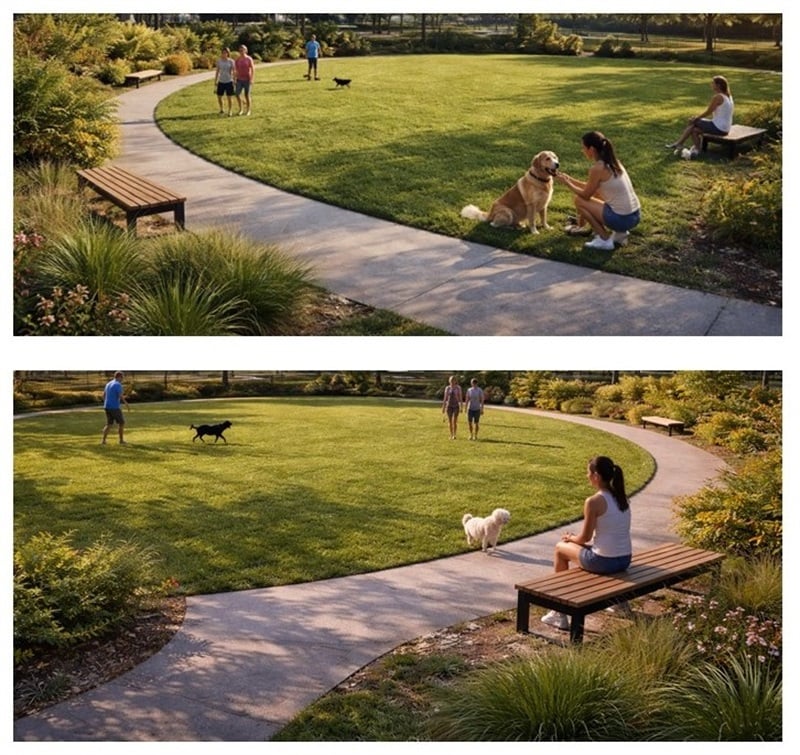
While the traffic project was being negotiated at the county level, a separate effort was moving through the Miami Forever Bond process. The result: a new dog park at 2201 SW 26th Street, at the intersection of SW 22nd Avenue and SW 26th Street, funded at $926,093.
The city broke ground on April 28, 2026. The site is currently a 5,000 square foot vacant lot. When complete, it will include a 6-foot perimeter fence, water fountains, and dog waste stations — the standard infrastructure for a functional off-leash space, not a passive green patch.
The Miami Forever Bond, which allocates $400 million across sea-level rise, roadways, parks, and public safety projects citywide, is the funding mechanism. For Silver Bluff, this is the Bond's most visible neighborhood-scale delivery to date. The location was chosen deliberately: it fills a gap in a residential area where the nearest comparable off-leash options require driving to David T. Kennedy Park on South Bayshore Drive or Blanche Park in Coconut Grove.
Two Projects, One Pattern
The dog park and the traffic program look like unrelated city initiatives. They aren't.
Both exist because Silver Bluff has a functional civic identity. The Silver Bluff Neighborhood Association has historically lobbied to keep commercial overdevelopment out of the area — and won. When the City of Miami tried to sell the vacant land at 2901 SW 22nd Avenue for private development after the original 1925 town hall building was demolished in 1972, neighbors organized and pushed for public use. That land became Marjorie Stoneman Douglas Park, also known as Silver Bluff Mini Park, which remains a neighborhood anchor today.
That same organizing muscle is what produced the 2025 county agreement and the Forever Bond allocation. The sequence across all three assets looks like this:
- Marjorie Stoneman Douglas Park, 2901 SW 22nd Ave — neighborhood-preserved since the 1970s, on the original Silver Bluff town hall site
- Silver Bluff Traffic Flow Modification, 26 locations — $7.8M, county agreement finalized November 2025, construction through Summer 2027
- Silver Bluff Dog Run Park, 2201 SW 26th St — $926,093 Miami Forever Bond, groundbreaking April 28, 2026
Three public investments in a neighborhood of just over a half-square-mile. None of them arrived automatically. Each required residents to stay engaged with a process that moves slowly and often seems unresponsive.
The thesis worth sitting with: Silver Bluff's public infrastructure isn't thin because the city forgot about it. It's been built incrementally, project by project, through sustained civic pressure from people who have lived here long enough to see the pattern and keep showing up anyway.
What Changes for Daily Life
The traffic modifications won't be invisible. Over the next 18 months, 26 intersections and stretches across the neighborhood will see physical changes — speed management devices, movement restrictions, and redesigned turning movements. Some of that construction will be disruptive. Some of the restrictions will redirect traffic in ways that feel inconvenient at first.
The baseline to hold in mind: right now, cut-through volume on Silver Bluff's residential streets is high enough that the county put it in a formal legislative memo as a safety concern. The modifications are calibrated to reduce that baseline, not to make the neighborhood inaccessible. Getting around within the neighborhood won't change materially; what should change is the volume of vehicles that have no destination there but use it as a corridor.
The dog park is more straightforward. The nearest off-leash spaces are a drive away. A fenced, watered, dedicated space at SW 26th Street and SW 22nd Avenue means that particular errand — the morning or evening dog run — becomes a walk rather than a trip. For a neighborhood described by its own residents as walkable and dog-friendly, that's a meaningful shift in how daily routines fit the street grid.
Taken together, the two projects push in the same direction: a residential neighborhood that becomes more comfortable for the people who live in it and less convenient as a pass-through for people who don't.
Silver Bluff has always had the location — positioned between Coral Gables, Coconut Grove, Brickell, and The Roads, close to everything without being consumed by any of it. What's changing in 2026 is that the city's investment is finally beginning to match what the neighborhood has known about itself for a long time.
If you're watching this neighborhood closely — whether you live here now or are thinking about it — Grace Blanco has been working in this market for more than 25 years and knows Silver Bluff from the ground up. Let's connect.