Two well-known valuation sources describe Pinecrest as if they were describing different villages. Zillow's Home Value Index puts the typical Pinecrest home at $1,814,430 as of mid-2026, up 9.2% year over year. Redfin's most recent monthly reading, from November 2025, puts the median sale price at $3.4 million, up 39.3% year over year at $779 per square foot. Movoto logged a June 2025 median of $3,165,000 with 100 days on market. That is not a rounding disagreement. That is a $1.6 million spread inside a single ZIP code.
The spread is the story. It is also the reason a buyer who anchors on any one of those numbers is going to misjudge every offer they write.
The $1.6M Gap Is a Signal, Not Noise
Pinecrest's sale medians are pulled upward by a small number of very large, very new estates. Redfin recorded only 18 closings in November 2025. When a market that thin includes new construction from builders like GILU Development, Pacheco Architecture, Hollub Group, and Borges Architects, the middle number moves with whichever spec homes happened to close that month. The ZHVI, which is modeled across the full standing stock, describes something closer to what a renovated original home on a standard lot is actually worth today.
Source | Reading | Window | What it captures |
|---|---|---|---|
Zillow ZHVI | $1,814,430 | Mid-2026 | Full standing stock, model-weighted |
Movoto median sale | $3,165,000 | June 2025 | Closed sales, small monthly sample |
Redfin median sale | $3,400,000 | November 2025 | Closed sales, 18 transactions |
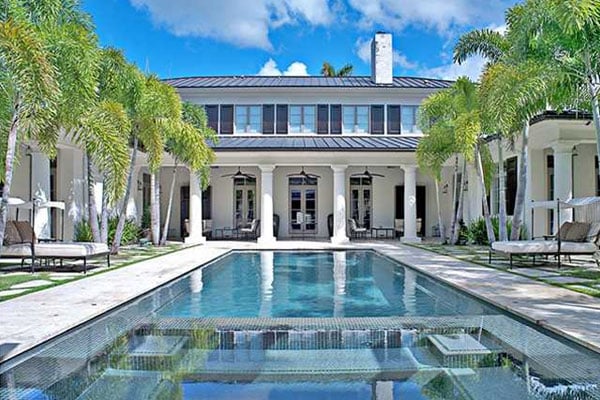
Read together, the three numbers describe two Pinecrests transacting side by side. One is 1960s-to-1980s ranch homes that have been updated, most sitting between $1.5M and $2.5M. The other is 6,000-to-11,000-square-foot new construction on acre-plus parcels, most trading between $5M and $12M. A buyer comparing per-square-foot comps between those two groups is comparing land-heavy trades to structure-heavy trades and getting a number that describes neither.
What the Land Is Actually Doing to the Comps
Pinecrest's estate-lot zoning is the mechanism behind the split. Because most residential lots are held at a half-acre to a full acre or more under the Village's land development regulations, buildable land is functionally fixed. The village's own land development code sets the setbacks, height limits, and lot coverage that keep the density from creeping up. That scarcity is why teardown and rebuild activity is now the dominant redevelopment pattern here, with buyers routinely acquiring an older home primarily for the parcel underneath it.
Active listings in mid-2026 show the pattern in the open. Casa Solara is marketed as a 0.69-acre lot with approved plans for a 7,196-square-foot residence. A 40,685-square-foot corner parcel is being sold as a "rare acre opportunity" with an existing ranch on it, with the marketing pointed at builders. An 11,000-square-foot Pacheco-designed spec home on nearly an acre in North Pinecrest was priced with a Q1 2026 delivery. When land carries this much of the value, price per square foot of house becomes almost meaningless. Two homes on the same street, both closing at $4.5M, can be a 3,000-square-foot renovation on a full acre and a brand-new 7,500-square-foot build on a half-acre. The per-foot numbers will read wildly different. Neither is a comp for the other.
The practical consequence for buyers is that the correct question during offer prep is not "what does this house cost per foot," it is "what would a builder pay for this lot today, and how much of that ceiling am I inheriting." That question can only be answered block by block.
The Envelope You Are Also Buying
The second thing the portal price hides is the cost of bringing an older Pinecrest home up to the code that governs every insurance decision on it. Pinecrest sits inside Miami-Dade County's High Velocity Hurricane Zone, and the Village of Pinecrest Building Department will not issue a window or door permit without a Miami-Dade Notice of Acceptance or Florida Product Approval on file for the exact product. That single rule shapes the total cost of ownership more than most first-time Pinecrest buyers expect.
For a typical single-story Pinecrest home with 15 to 20 openings, the current 2026 market for a code-compliant impact package looks like this:
- Per-window installed cost of roughly $800 to $2,500, depending on size and glass package
- Whole-home projects with 10 to 20 windows and 2 to 4 doors landing between $15,000 and $55,000
- Permit review at the Village of Pinecrest Building Department running 10 to 21 business days
- Contract to final permit sign-off in the range of four to six weeks on a straightforward retrofit
- Annual homeowners premiums on a $600,000 Pinecrest dwelling running between $5,000 and $9,500 in 2026, with larger estates well above that range
- Documented wind mitigation credits that can reduce the annual premium by 20 to 45 percent when the full package is on file
A buyer looking at a $2.4M original home that still has its 1990s aluminum openings is not looking at a $2.4M home. They are looking at a $2.4M home plus a $30,000 to $45,000 envelope project that will take a permit cycle to close and will change the insurance underwriting outcome. A buyer looking at a comparable home already retrofitted, with the Florida wind mitigation form, the NOA numbers, and the permit sign-off in the seller's file, is looking at a materially different asset. That difference rarely shows up cleanly in the list price.
Flood is a separate underwriting question that runs parallel to wind. Portions of Pinecrest fall inside FEMA Zones AE and X depending on elevation and proximity to the canal network, which a buyer can verify on the FEMA Flood Map Service Center before writing an offer. A standard HO-3 policy excludes rising water on both.
Why 134 Days on Market Is the Honest Number
Redfin's November 2025 average of 134 days on market, up from 121 the prior year, is often read as softness. In an estate-lot market where each home is essentially a custom transaction, it is closer to a truth-telling number. Movoto's June 2025 average of 100 days, up from 70, tells the same story from a different vantage point.
What actually moves in Pinecrest right now are homes priced against current comps rather than 2024 headlines, with the mitigation documentation assembled in advance and the lot's redevelopment ceiling honestly reflected in the ask. Homes without that preparation sit, and they sit for a long time, because the buyer pool is small, patient, and unusually well informed. For a seller, this is the difference between a summer closing and a listing that carries into the winter selling window. For a buyer, it is the reason that a home approaching the 120-day mark is often more negotiable than the sticker suggests, particularly if the mitigation package still needs to be built out after closing.
A Short FAQ for Buyers Comparing Pinecrest to Coral Gables and South Miami
If the Zillow number is $1.8M and the sale median is $3.4M, which one am I actually going to pay? Neither, on its own. The answer depends on which of the two Pinecrests you are buying into: an updated original home on a standard lot, which tends to trade closer to the ZHVI, or a newer build or acre-plus parcel, which lives in the sale-median band. A block-level comp set is the only reliable read.
Does a home already having impact windows really matter that much? Yes, for two reasons the portals do not capture. It removes a permit cycle and a $15,000-to-$55,000 line item from your first year of ownership, and it changes the insurance quote you can obtain on day one, provided the seller can produce the Florida wind mitigation form, the NOA numbers, and the final inspection record.
How do I know if a Pinecrest lot has real teardown value? Lot size, street, canopy, elevation, and the Village's setback and coverage rules together determine what a builder could actually place on the parcel. The math is specific enough that most experienced Pinecrest buyers run it against a target floor plan before writing the offer, not after.
The Pinecrest market rewards buyers and sellers who work from the parcel outward rather than from the portal inward. If you are weighing a move into the village, weighing a sale, or trying to make sense of a specific block against its comps, Graciela Blanco would be glad to walk the numbers with you in person. Let's connect.