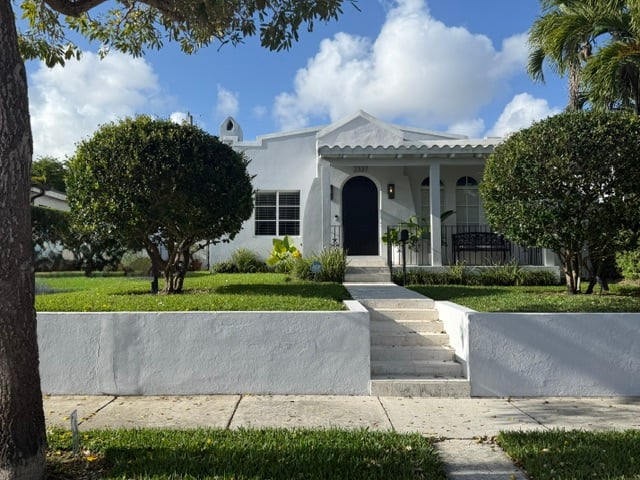
Silver Bluff covers just over a half square mile, bordered by U.S. 1 to the south and Coral Way to the north, running between Southwest 27th and Southwest 12th avenues. It is mostly single-family homes, the kind of neighborhood people drive through on the way to somewhere louder. Most years, nothing here makes the news.
This year is different, and the strange part is how concentrated the difference is. A new dog park is going in at the intersection of SW 22nd Avenue and SW 26th Street. A few blocks west, at 1900 SW 25th Terrace, a mural spanning two building walls is finishing installation this month. And running underneath both, threading through 26 separate intersections across the neighborhood, is a traffic redesign that started last fall and won't wrap until the summer of 2027. None of the three projects were planned together. They share no budget, no agency, and in one case, no public funding at all. They just happen to be landing in the same small neighborhood in the same year.
A Public Bond and a Private Commission, Streets Apart
The dog park broke ground on April 28, 2026, on a roughly 5,000-square-foot vacant lot that had sat unused for years. The city is putting $926,000 toward it, funded through the Miami Forever Bond, and the finished space will include a 6-foot fence, water fountains, and dog waste stations. It is a small, specific fix for a small, specific gap: a neighborhood with no dedicated off-leash space getting one, paid for with money voters already approved.
Walk a few blocks west and the funding story flips entirely. At 1900 SW 25th Terrace, a mural titled "Rooted in Cuba, Rising in America, Strength in Gratitude" is going up across two exterior walls among a cluster of five Art Deco buildings. The artist is Jerónimo Gauna, a Miami-based architect and multidisciplinary artist selected by La Victoria Miami Collection, a private art group co-owned by Laura Antuña Capestany and Jimmy Capestany, after reviewing submissions from local and international artists. The imagery includes flowing flags, José Martí's white rose, a tocororo in flight, and three women carrying the island's history forward in the composition. There is no bond money in this one. The selection committee included Geo Darder, who curates La Victoria's internal art collection and also founded the Copperbridge Foundation, and the project drew in partners with no obvious reason to share a mural commission: City of Miami District 4 Commissioner Ralph Rafael Rosado's Arte D4 initiative, The Underline, and Florida International University. The work was expected to be finished within the month of its September announcement, which puts its completion right around now.
Put the two side by side and the contrast is the point. One project moved through a public bond, a groundbreaking ceremony, and a city capital-improvements page. The other moved through a private company's art committee and a handful of institutional partners who signed on. Both landed in the same small neighborhood in the same year, funded by nothing alike.
The Traffic Study That Outlasts Both of Them
The largest of the three projects, and the slowest, is the one most residents are already driving through without a name for it. The city is modifying traffic flow at 26 locations across Silver Bluff, a project expected to cost more than $7.8 million, under an agreement county commissioners approved unanimously in November 2025. That agreement matters more than it sounds like it should: it lets the city install pre-approved traffic-calming designs without going back to the county for sign-off on each one, which is the difference between a project that moves in phases over months and one that stalls waiting on hearings. City officials, including Charles Alfaro of the Department of Resilience and Public Works, have framed the goal plainly as reducing cut-through traffic. The project's own city timeline runs from September 2025 to the summer of 2027.
This is not Silver Bluff's first attempt at the same problem. In 2017, a traffic-calming project on SW 22nd Avenue got far enough to install temporary plastic delineators before Commissioner Francis Suarez pulled the funding and sent the city back for a new traffic study, after residents split over whether the changes helped or just pushed congestion onto other streets. By 2021, the city had shifted tactics, using a $232,500 Florida Department of Transportation grant to fund off-duty police overtime for speed enforcement instead of physical infrastructure, a program that required no matching city funds. The current 26-location project is the version that finally has both money and a streamlined approval path behind it, which is likely why it is the one actually moving dirt instead of triggering another round of delineator complaints.
For anyone living inside the SW 27th to SW 12th footprint, this means the coming months will bring visible construction on streets that have not seen this kind of coordinated work in years, not a single ribbon-cutting but a rolling sequence of intersections getting redesigned one at a time through 2027.
The Land Under All of It
There is a pattern here that predates any of this year's projects, and it shows up elsewhere in Silver Bluff, at what is now called Marjorie Stoneman Douglas Park, at 2901 SW 22nd Avenue. The park sits on the original site of the 1925 town hall, fire station, and police station for the short-lived Town of Silver Bluff, which existed as its own incorporated municipality from 1921 to 1925 before being folded into the City of Miami. When that original building was torn down in 1972, the city put the land up for sale for private development. Neighbors pushed back, the sale didn't happen, and the parcel became a public park instead, first known as Silver Bluff Mini Park.
That fight from more than 50 years ago is the same basic negotiation playing out again this year, just distributed across three separate projects instead of one contested lot. A small footprint of land, a question of who gets to shape it, and a resolution that ends up mixing public money with private initiative rather than picking one or the other. The dog park is public land turned to public use through bond financing, the closest modern equivalent to the 1972 fight. The mural is a private company deciding a blank wall deserved something more than blank, without waiting for a city program to fund it. The traffic project is the city trying to fix a problem residents have been raising since at least 2017, this time with the money and the paperwork lined up to actually finish it.
By the time the traffic redesign wraps in the summer of 2027, someone driving from the new dog park on SW 26th Street over to the finished mural on SW 25th Terrace will likely pass through several of those 26 redesigned intersections without necessarily knowing that's what they're crossing. Three different processes, three different sources of money, one small neighborhood absorbing all of it at once.
If you're curious how changes like these tend to shape a neighborhood's character and its long-term value, Grace Blanco has spent decades watching Miami's smaller pockets evolve one block at a time. Let's Connect.